Strong leadership in home care often comes down to understanding people before trying to solve problems. Whether it’s earning the trust of an experienced team, helping a franchise owner overcome operational challenges or guiding a business through rapid growth, success depends on knowing when to lead, when to listen, and when to ask the right questions.
For franchise support teams, this also means recognizing that every owner is at a different stage of their journey. The leadership approach that helps a new business find its footing may look very different from the one needed to manage a multimillion-dollar operation. As networks grow, the ability to adapt that support becomes just as important as the systems behind it.
At the same time, AI is creating new opportunities to improve operational efficiency and give teams more time for meaningful engagement. The challenge is using technology to strengthen relationships while building the documentation and accountability practices that will shape home care’s future.
To shed light on this, we interviewed a home care industry expert to bring his perspective on adapting leadership to franchise owners’ needs and helping them build successful home care businesses.
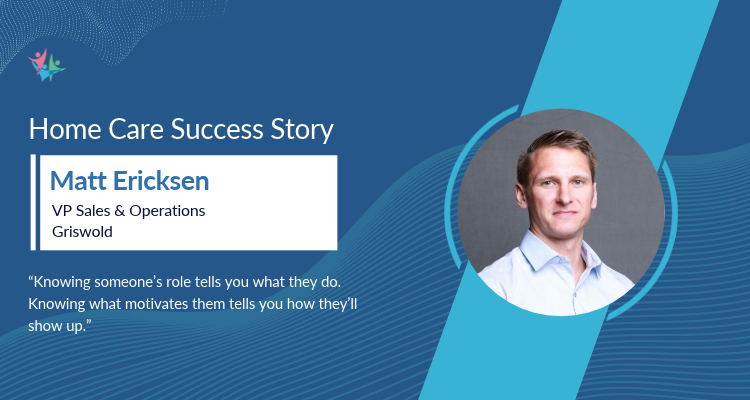
As VP of Sales & Operations / Franchise Support at Griswold, Matt Ericksen focuses on helping franchise owners navigate business challenges, strengthen their teams, and grow at every stage of their journey. His leadership approach centers on understanding people, building accountability, and adapting support to each owner’s needs.
Through operational improvements and thoughtful adoption of AI, Matt champions a people-first approach to growth. Thus helping franchise teams work more effectively while preserving the relationships at the heart of home care.
Let us now delve into what he has to say about how a people-first franchise drives growth and strengthens care operations.
Early in my home care career, I was asked to take over a recently acquired office in an isolated part of New Jersey. It was a role others had passed on. The office needed a full rebrand, and we had to keep every client and caregiver through the transition. I was in my mid-20s; it was my first leadership role, and most of the team had 20 years on me. Their question was fair: who is this, and is he about to make my job harder?
My instinct was to step in, take charge, and dictate how things would go. That would have failed. I had to slow down, listen, and observe before acting. I started with our nursing director, someone the whole team respected, and asked her to lunch once a week, away from the office. Those lunches weren’t status meetings. They were a chance to know the person behind the position, and for her to know me.
It was humbling, and it was the best leadership lesson I’ve had. It still shapes how I lead my own team and coach franchise owners. Knowing someone’s role tells you what they do. Knowing what motivates them tells you how they’ll show up. The habit I took from that office is simple: check in on the person, not the position.
I once worked with a franchise owner whose business was falling behind its goals for the year, and on paper, it didn’t add up. The owner was capable. The team was capable. Each person was doing good work in their own role.
Reports can paint a convincing picture. Without real conversation behind them, they can also tell a false story. So, we went old school. We sat down with a blank Monday-through-Friday calendar and walked through the owner’s week, hour by hour. I wanted to see how the team was being led.
What we found was intent to lead, but not execution. The owner focused on the part of the business they enjoyed most and trusted the team to fill the gaps everywhere else. That is delegation without follow-through. Nobody was checking whether these smart, competent people were working together. Without that, assumptions went unchallenged and the team stopped functioning as a team.
My recommendation was to elevate the highest-potential staff member into a true number two: someone who would lead the team on-site and keep the owner informed on everything. Instead of managing the whole team from the field, the owner had one point of contact to trust, verify, and hold accountable. It developed both of them. The staff member stepped into a first real leadership role, and the owner learned to lead through someone else. We kept checking in with both, and the office worked its way out of the dysfunction into a team built on communication, and the business has grown every year since.
One of the books that most changed how I lead is Greg Nathan’s The Franchise E-Factor. Nathan describes the stages franchisees move through: Glee, Fee, Me, Free, See, and We. It’s something of a roller coaster, from early excitement, to questioning the value of the franchisor, to wanting independence, and ideally to a genuine partnership. Understanding those stages helped me see an owner’s concerns, how they define success, and how they view us at any given moment, and it made me a far more effective leader.
That lens shapes how I adapt. Coaching an owner working toward break-even looks very different from advising one running a complex, multimillion-dollar operation. Many of our owners had accomplished careers before home care. My job isn’t to replace the skills that made them successful. It’s to help them translate those skills into an industry built entirely on relationships.
Growth changes what an owner needs, too. We’ve worked with owners who built their businesses from zero to more than $2 million in revenue in a short time.
Growth that fast can outpace the leadership habits that got them there. At that stage, telling them what to do rarely works. Asking the right questions does. When owners reach the answer themselves, they own it, and both their leadership and their company can move forward.
With Griswold’s rapid expansion and growth of new franchise locations in the past three years, we saw that processes were going to be strained if left unchanged. When generative AI arrived, I started looking at my team’s workflows to see where it could help. Since then, I’ve built a suite of AI agents and enablement tools that help our franchise business coaches do what I call “collapsing time on task”: reaching the same outcome in a fraction of the time.
Call documentation is the clearest example. As a team, we were spending about 17 hours a week writing up franchise owner interactions. In busy weeks, notes came in late or inconsistently, and we never had a complete picture of our communication with owners. With AI-generated transcription and summaries, coaches now capture objectives, takeaways, and action items in minutes. That brought our time from 17 hours a week down to 1 hour.
We reinvested those 16 hours into owner engagement and into finishing initiatives faster, and we’ve replicated the approach across other workflows. What I’m proudest of isn’t the technology. It’s that our team supports a fast-growing brand with less fatigue and burnout, and with more of their time going to the owners themselves.
This is as much a cultural question as a business one. AI is a multiplier. It amplifies whatever is already true about your organization. If your business is genuinely people-centric, and that’s non-negotiable in how you operate, AI will be applied in ways that protect it. If communication was poor before AI, AI won’t fix it. It will mask it, and eventually that breaks.
We treat AI as an enablement tool. Applied in the right places, it gives each person on the team more time for personal engagement, not less. That matters, because over the last decade technology has steadily replaced conversation with texts, emails, and likes. I see a real and growing desire for human connection again, and home care is built on it.
So leaders have to ask a hard question: just because I can do this with AI, should I? We’re operating in a long-standing caregiver shortage. When we deploy a tool, is it serving caregivers, clients, and families, or is it just making an office headache go away? AI can make our jobs easier, but we have to ask at what cost. Home care is, and always will be, a people business. The test for any AI tool is whether it strengthens those relationships or quietly erodes them.
What excites me most is home care’s growing credibility. Clinical leaders and policymakers increasingly recognize how consistent care at home can reduce hospitalizations, lower fall risk, and improve quality of life.
Programs like CMS’s GUIDE model, VA partnerships, and state aging initiatives are creating new opportunities. Documentation is key to accessing them. The 2026 Activated Insights Benchmarking Report found that providers tracking hospital admission rates rose from 25.4% to 31.6% year over year.
Agencies that document care accurately can demonstrate outcomes, strengthen referral networks, build health system partnerships and improve reimbursement opportunities.
My advice: treat documentation as a growth strategy, not just a compliance task. Build that discipline before payers require it and position your agency as a trusted partner in the care continuum.
Understanding people, adapting to their needs, and building accountability can help franchise owners overcome challenges and develop businesses that continue to grow. As home care evolves, AI and better documentation offer new ways to strengthen operations and prepare for future opportunities. But the real measure of progress is how well these improvements support the people behind the business. For home care leaders, the goal is to build systems that enable growth while keeping relationships at the center of care.
Our users reported 95% customer satisfaction in 2025. Schedule a personal walkthrough to see CareSmartz360, home care software in action.
 AI Hub