Most agencies already have relationships worth building upon. What they need is the time to nurture them consistently. And this is very true of home care referrals.
Building referral relationships takes time. And for home care agencies, getting those relationships to produce a steady flow of clients is another challenge altogether.
A hospital case manager or senior living director may know several home care providers. What makes them call one agency over another? Often, it's the agency that answers the phone, follows up when promised, shows up for meetings, and can actually staff the case.
These details can make or break a referral relationship. Yet outreach often gets pushed aside as owners deal with staffing, scheduling, payroll, and day-to-day operations.
To shed light on this, we interviewed a home care industry expert to share their expert view on what agencies can do to build stronger referral networks.
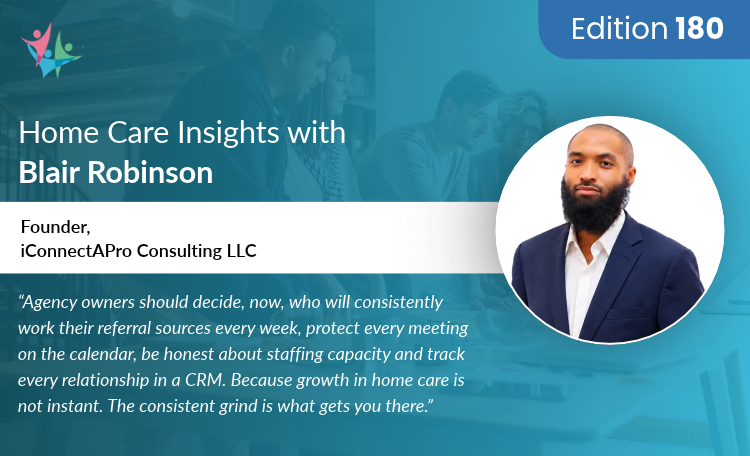
Blair Robinson is the Founder of iConnectAPro, a business development service for home care, home health, and hospice owners. He helps agencies identify professionals in their communities, connect with referral sources, and secure meetings that can lead to new business opportunities.
His work focuses on the practical side of referral development, i.e., finding the right people, staying in touch, and making sure agency owners have consistent opportunities to build relationships in their communities.
Let us now delve into what he has to say about making referral relationships a more consistent part of home care business growth.
The biggest mistake is treating referral development as an event instead of a process. An owner drops off brochures, has one good conversation with a discharge planner and then nothing happens for two months. By then, that person has moved on, or simply remembers the agency that called last week.
The second mistake is assuming connections equal referrals. I talk to owners every week who say that we know the right people, but we just need them to send clients right away. You see, knowing someone is not the same as staying in front of them. The agency that shows up consistently usually wins over the one that knows its people best.
The third mistake is relying on the owner alone. Owners are running payroll, staffing cases and handling families. Outreach is always the first thing to slip. And finally, some agencies try to shortcut the process with gifts, meals or perks. In healthcare, that can create real legal exposure. Consistency and good service are the only sustainable advantage.
Start by understanding that each one of the referral sources works differently. Hospital case managers are under heavy time pressure and many hospitals lean toward the large, all-in-one agencies so those relationships take longer. Skilled nursing social workers and senior living directors are often where independent and franchise agencies gain traction first because they discharge or support residents every week and value a reliable partner.
Then build a rhythm. In our work, every facility on an agency's list is contacted consistently, month after month. After an introduction, the relationship moves into touchpoints on a rolling basis across calls, email, availability updates, short newsletters and useful education for their team, so the agency stays top of mind long after the first meeting.
Go beyond one contact per facility. A skilled nursing facility has a social worker, a director of nursing, an admissions director and sometimes a liaison. Staff turnover is constant, so when someone leaves, find and meet the replacement quickly. Partnerships come from being dependable over months, not from one great meeting.
They are everything. Referral sources and families are usually calling more than one agency. The first agency to answer, ask good questions and offer a clear next step often gets the client.
My advice is simple and straightforward. Answer questions live, especially during business hours, and as proactively as possible. If a call goes to voicemail, return it within the hour. Offer a specific time for an assessment instead of asking when they are free. And close the loop with the referral source. Let them know you reached the family and what happens next. That one courtesy call is often what earns the second referral.
The same principle applies to the relationship side. When a discharge planner sends you a family, and you handle it well and quickly, you have proven yourself. When you are slow, you may not get another chance. Delivery is your best marketing.
Use technology for everything that happens before and after the conversation, and keep the conversation human.
AI and automation are excellent for research, such as identifying the right decision-makers and verifying titles. They are also excellent for keeping a CRM current, triggering follow-up emails after a call, scheduling tasks so no one falls through the cracks, and producing reports that show every call and conversation. That gives owners full transparency into what is actually happening.
What should stay personal is the relationship itself, i.e, the phone call, the in-person meeting, how you handle a difficult case. A case manager will not remember your automated email. She will remember that you called back in 20 minutes and took a complicated discharge on a Friday afternoon.
One caution though. Be careful with tools that bulk-blast messages or automate social media connections. They can damage your reputation and violate platform rules. This is to say that automation should make you more consistent and not less personal.
I expect four things.
First, more competition for the same referral sources. More agencies are entering the market, and a discharge planner or senior living director may hear from dozens of agencies every month. In that environment, reliability is your first impression. We have seen it firsthand – an owner who misses or reschedules a meeting with a referral source has already told that person how dependable they will be, long before the first referral. When a social worker makes time for you, protect that meeting like it is a client visit. Because to them, it is a preview of how you will treat their patients.
Second, staffing will decide who gets referrals. The caregiver shortage is not going away any soon. And referral sources remember which agencies said yes and then could not staff the case. So, ensure you only accept what you can cover and tell partners honestly about your capacity.
At the end of the day, being the agency that always follows through is worth more than being the agency that always says yes.
Third, competition for hospital referrals will keep tightening as health systems favor larger and all-in-one providers. Agencies that diversify into skilled nursing, senior living, care managers and home health partners will be in a stronger position. And more owners will move away from paying for shared leads that go to several agencies at once, toward building referral networks they actually own.
Fourth, compliance will matter more. In home health and hospice, offering anything of value in exchange for referrals can be a federal crime and many states have similar rules. Agencies need a referral strategy that is clearly ethical and well documented.
To prepare, owners should decide now who will consistently work their referral sources every week, protect every meeting on the calendar, be honest about staffing capacity, and track every relationship in a CRM. Growth in home care is not instant. The consistent grind is what gets you there.
Referral growth does not happen because an agency knows more people. It happens when those people have a reason to trust the agency and send business its way.
Blair's advice comes down to a few fundamentals – make time for outreach, follow up promptly, show up for meetings and never promise a level of service the agency cannot deliver. Technology can help teams stay organized and keep track of conversations. But it cannot replace the trust built through personal interactions and dependable service.
For agency owners, the takeaway is clear – referral development needs a regular place in the weekly schedule. The relationships built through that effort can become one of the most dependable sources of new business.
Our users reported 95% customer satisfaction in 2025. Schedule a personal walkthrough to see CareSmartz360, home care software in action.
 AI Hub