The Future of Home Care: Who Pays, Who Qualifies, and What Changes Next?
00:00:09
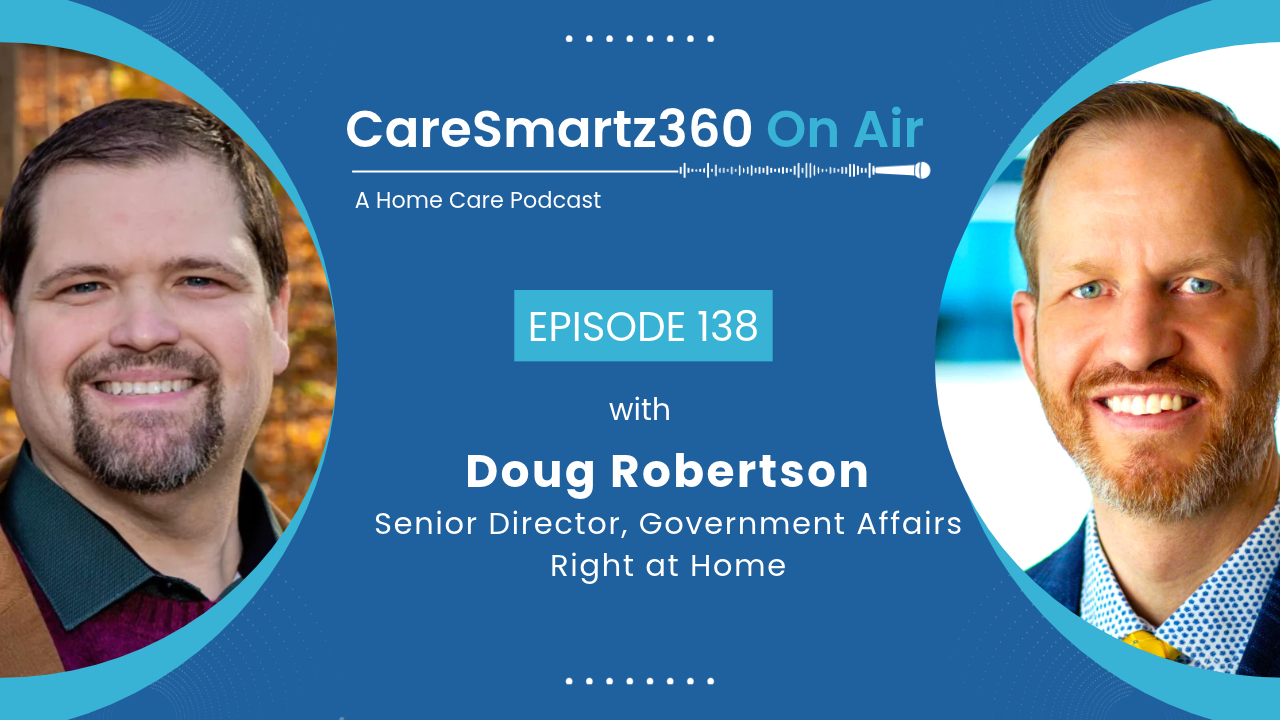
Hello and welcome to CareSmartz360 On Air. I’m David Johnson, Director of Sales at CareSmartz360. Join us as we welcome Doug Robertson of Right at Home. Doug brings a policy and advocacy perspective on the non-medical home care industry, with experience in government affairs, state licensing and legislative advocacy. His work with the Home Care Association of America has also focused on addressing challenges home care providers face when working with government programs, particularly the VA. In this episode, we’ll explore
00:00:41
the policy and regulatory changes shaping home care, the growing role of non-medical care in the broader healthcare system, and the opportunities emerging across Medicare Advantage, Medicaid, and VA programs. We’ll also discuss how agencies can navigate regulatory challenges, make their voices heard, and prepare for the policy and reimbursement changes that could shape the industry’s future. Welcome to the podcast, Doug. >> Thanks for having me, David. Really appreciate the time , to be here and to
00:01:09
talk about these really important topics. I think um home care is really in a great place right now in the health care ecosystem , to make a difference in the lives of a lot of folks. 100% agree. So, from where you sit, what are some of the biggest policy and regulatory changes that home care providers should be paying attention to right now? >>> Well, you know, I think I have a unique advantage point in that , I lead a government relations team that is watching , home care policy both
00:01:41
nation wide in the nation’s capital as well as in the state capitals. , our team of three, ,, provides government affairs support for our 450 locations across the country in the bride-at-home network and , we have some locations that provide some , skill services as well as , most of our locations provide non-medical home care , assistance with activities of daily living , for high volume, ,, high clients. And that’s really kind of a unique subset in, ,, health care. And I think some of the things that
00:02:19
that our company right at home as well as H2A members are watching are really a multiple , number of items. ,, first, ,, for those that provide care for Medicaid beneficiaries, they’re watching closely to see if the administration, ,, rolls back an 8020 requirement, which would require 80% of Medicaid reimbursement to be attributed to compensation for direct care workers and limit administrative overhead, including the cost of operating the business and profit, to 20%. and h to have a blanket 8020
00:03:02
proportion set nationwide regardless of any type of local factors. I think that that was really kind of some misguided policy >> and we’re looking forward to seeing that rolled back. But that is something that those involved in Medicaid are watching. I think home care agencies in general are seeing some opportunities with other items that are coming from the federal government, including guides, which is an alternative payment model from the Centers for Medicare and Medicaid Innovation Services that, ,, allows for
00:03:36
home care agencies deliver rapid care but also be a channel for the guide wraparound suite of services that includes caregiver education. ,, family caregiver education, family caregiver rest it support, ,, a 247 hotline for a family member that’s caring for someone with dementia to call and get clinical support. ,, as well as, ,, care, ,, coordination amongst the different providers that the ,, person with dementia, ,, is receiving care from. It’s available to those with original Medicare and those with
00:04:13
dementia. And so that’s about half of the Medicare population that would be eligible if they should eventually have a dementia diagnosis. >> Got it. A lot there. As more care moves into the home, how do you see the role of non-medical home care changing within the broader health care system? >>> Yeah, I think that that’s an interesting question. ,, the pandemic really puts an emphasis on care in the homes. Care in the facilities was very difficult, ,, to
00:04:49
do during the pandemic as folks were trying to keep patients separated because of the spread of the disease, and, ,, care in the home seemed to be the most logical conclusion. Out of that, ,, we saw , an acceleration of hospital-at-home programs where hospitals were either providing hospital care in homes or perhaps providing more post-acute care in the home setting. ,, and that has led to the hospital-at-home movement, ,, along with the renewal of the waiver from CMS to allow that to continue. ,,
00:05:27
I think care in the home is a topic that is much more on people’s minds now than it ever was before in part because of the pandemic. We’re also seeing that play out in Congress. There have been numerous , federal bills introduced to create an in-home Medicare, ,, funded benefit to provide ongoing assistance with activities of daily living. As currently, the Medicare home health benefit does not provide ongoing assistance with ADLs. It provides a short-term , solution for acute injury or illness.
00:06:02
with nursing services and therapies in the home for a brief period of time. but what folks really need is ongoing support so that they can continue to have their lives and their jobs and continue to work while knowing that someone is at home caring for their loved ones. So, there’s more federal legislation being introduced to , propose those solutions. , the Senate finance committee Democrats have recently issued a request for information about how we could have more care in the home paid for by a
00:06:39
collaboration of Medicaid as well as Medicare. >> Fantastic. Where do you see the biggest opportunities for home care agencies within Medicare Advantage? Medicaid and VA programs. >>> Yeah, I think it’s important for home care agencies to track changes with policy h so that they know where to make the right move. You know, Medicare may not have a benefit that provides ongoing support with ADLs for all Medicare beneficiaries. But the guide presents an opportunity for those to enroll with a participating organization
00:07:16
that’s a channel for guide dementia support for original Medicare beneficiaries. Medicare Advantage has more limited opportunity with the in-home supplemental benefits, which may or may not be offered in every zip code and may or may not include an in-home support benefit, but it’s something to explore. Medicaid, I think, is an opportunity for those agencies and states where the reimbursement and the support for Medicaid services going forward are substantial. ,, that requires some political alignment to kind of
00:07:52
overcome the inertia against spending more on Medicaid. VA right now is the VA community care network, which is a saturated network. It’s been in existence now for about six years, and, ,, it does—they don’t need more providers in a lot of locations. ,, so I don’t think that’s so much of an opportunity for a new agency as it was maybe 3 or 4 years ago. ,, but, ,, in the future we’ll see what happens because the VA is rolling out a new iteration of the VA community care network called NextGen
00:08:26
and we’ll see if that presents any additional opportunities for home care agencies. Awesome. What are the biggest barriers that make it difficult for home care agencies to participate in government-funded or health plan programs? I think when there are strings attached and additional requirements, you know, for those serving the Medicaid population, you know, now there is these 8020 rules that are in place. won’t go into effect until 2030 unless it’s repealed before then. You know, that’s a
00:08:59
a string that’s attached to that source of revenue that can make that very challenging. ,, and even without the 8020 provision going into effect in 2030, there is a reporting mechanism that states have to comply with in the Medicaid access rule that will require them to report to the federal government what the percentage of Medicaid reimbursement that is spent on caregiver wages. And, ,, that reporting rule really starts in 2028, but it’s going to look back as far back as
00:09:33
January 1, 2027, payments issued on that date and forward. So I think home care agencies need to really start thinking about whether or not they’ll be able to comply with those reporting requirements. I know that’s something that we’re looking at here right at home. , so it’s when there are strings attached the VA is going to implement electronic visit verification in the next G network, and so that will be an additional layer of administrative oversight that will probably lead to
00:10:02
more audits of home care agencies. so I think homecare agencies just want to stay abreast of all the requirements that are tied up with some of these reimbursement programs , so that they can really anticipate the true cost , and the time involved with participation. >> Got it. Devales directly into my next question about how well homecare agencies can stay ahead of regulatory changes without adding unnecessary complexity to their day-to-day operations. Well, I think the thrust of this
00:10:34
interview is focused on the non-medical home care agency community, and I think it’s very wise for those providers to belong to the Home Care Association of America, ,, as that is the preeminent voice in Washington as well as state capitals for , those agencies that are in the home, for many hours every day, providing, support with activities of daily living watching for changes of condition , interacting with the family on an ongoing basis, and, oftentimes, becoming a very key part
00:11:09
of that family network of support in the home. So that would be the association join and make sure that the home care agency is paying attention , to what’s happening in Washington and also engaging with their policy makers by talking to their state legislator, talking to their US senator their member of Congress about the jobs that they create, the opportunities that they create for families to have some respite from the stress and burden of providing care to a loved one, and really paying
00:11:44
attention to the policy space, not just focusing solely on operations. Got it. What do you think that policy makers need to better understand the realities the actual home care providers face today? >> There are three components in the delivery of care in the home. There’s the patient, there’s the provider, and there is the direct care worker, provider, meaning the agency, the leadership that is training that caregiver, supervising the care, supervising the quality of care that’s
00:12:21
delivered. Policy makers need to understand all three of those constituencies: the patient, the direct care worker, and the agency. And policymakers need to have proposals. They need to have reimbursement. They need to have training requirements and understanding of documentation of care delivery training that’s administered and client satisfaction , reimbursement policies all need to consider all three of those individuals. And in the case of government-funded m care, it needs to
00:13:00
take into account the taxpayer as well and whether or not something is feasible in the long term because of the expense incurred. So, I would like to see policymakers really give some deference to what impact their policy has on the number of hours that a client could receive in the home. What does their decision mean for the long term, the longevity rather of the home care agency, the viability of the business operation, and, ,, what do those policies , mean for the direct
00:13:38
care worker? Are they going to be able to have all the hours of care that they want to deliver so that they can have the source of income , that they desire and the flexibility of the scheduling that they desire as well? >> Understood. How can home care providers have a stronger voice in shaping the policies that affect their agencies, their caregivers, and their clients? I think being engaged with their state association, their national association, and also banding together for
00:14:13
example the home care providers in a state need to band together to be a collective voice , for home care in their state. , non-medical own care is , more so regulated at the state level than the federal level. And so a governor, as well as the state legislature are going to have much more oversight over the requirements that pertain to state lensure, training requirements, administrative requirements as well as any , state funded reimbursement whether that’s Medicaid or any other type of ,
00:14:51
reimbursement in that state for home care. And so I think being engaged at the state level is probably the the number one , way that they can have a strong voice in shaping policy. And then as I mentioned earlier, belonging to the Homeare Association of America, I think is a a wonderful way for them , to have an avenue to influence policy in Washington , through the strength of an association that has a nationwide presence. And to kind of complete that line of thought, looking ahead, what policy or
00:15:26
reimbursement changes could have the greatest impact on the future of home care? I think if there were to be a Medicare benefit, to provide ongoing assistance with activities of daily living, with some guardrails around that benefit, such as we found and introduced in the expanding care in the home act in the 118th Congress. I think that that was a really good, um, proposal. It had bipartisan support in the bill sponsors, and that would provide some care, up to 144 hours of support.
00:16:11
with ADLs; for those that were frail and needed assistance, I believe it was two or three ADLs and were recently discharged from the hospital, because I think if there is a focus of funding support for those that are most frail, their most vulnerable moment, that really needs to be focused on those recently discharged from a facility. They’re going to need assistance with nutrition and medication compliance; they’re going to need someone there to watch for any change in their
00:16:45
condition that might lead to a readmission, and perhaps they could head off that readmission and decrease health care costs going forward. So I think a targeted approach with a Medicare-funded ADL benefit is something that we could see in the next several years introduced. I think guide is just a taste of what that might look like, which also is a targeted benefit for those that are considered frail with a dementia diagnosis and are oftentimes high users of Medicare services. And I think guide
00:17:22
is going to show that targeted benefit is going to reduce Medicare expenditures in the long term. That’s a really great case study, for I think a standard Medicare benefit for ADL support in the future that you’re right. You know, as we think about the interesting times in which live, there’s going to be, you know, some fundamental policy changes that are coming up here in the next several years, like you said. So, um, I just want to say thank you for joining us today. Thank you for your insight. Um, some
00:17:54
pretty powerful things, and, yeah, thank you. >>Hey, great to be here, David, and thank you for the time. You know, I really believe the future of home care will be determined by whether or not our society will continue to treat home care as a private family responsibility or begin treating it as an essential health care infrastructure, that needs to be recognized, paid for, and supported on a long-term basis. >> Agreed on all accounts. Thank you. >> You’re welcome.
 18:30 MINS






 AI Hub