49:08 MINS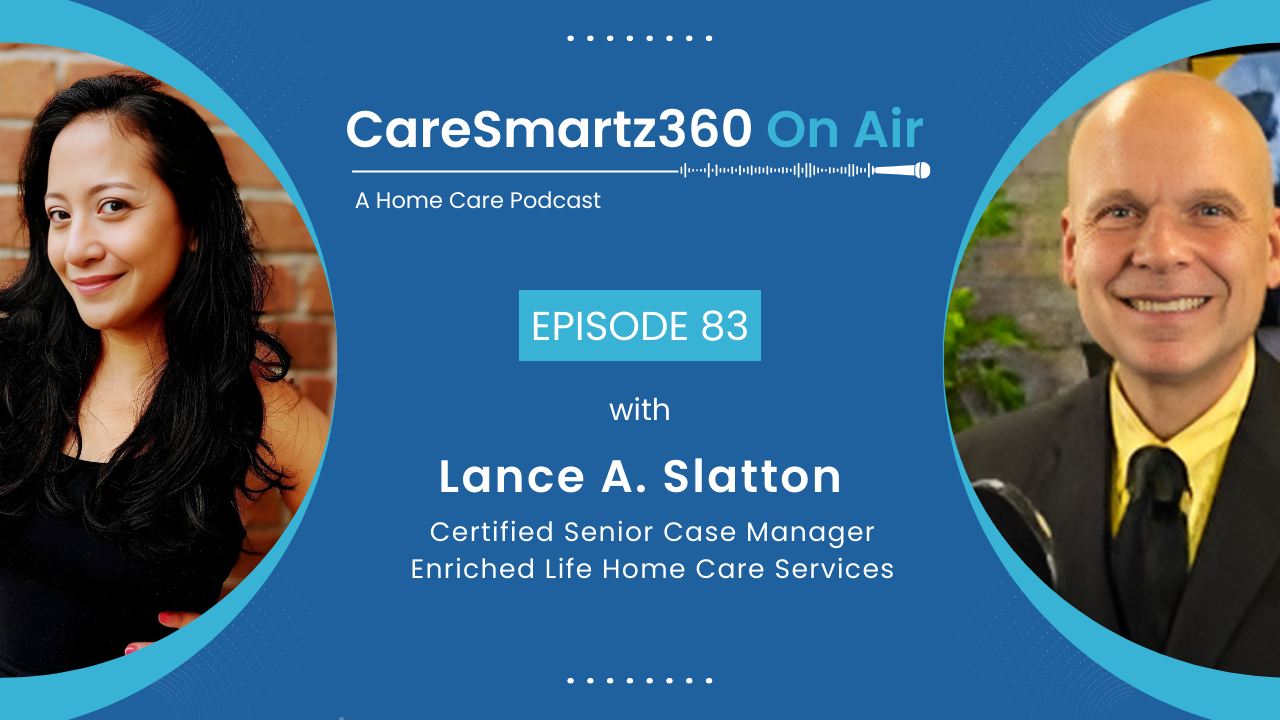
Join us as we welcome Lance A. Slatton, Certified Senior Case Manager at Enriched Life Home Care Services, with more than 13 years of experience leading dementia-informed care and caregiver training innovations.
In this episode, Lance introduces the concept of caregiver “pre-victories”—proactive strategies that empower caregivers before challenges arise. From building stronger training foundations and setting healthy boundaries to recognizing early burnout signs, he offers actionable strategies to strengthen caregiver resilience.
Trusted by 1,000+ Leading Home Care Agencies






Introduction
00:00:03.130 –> 00:00:20.500
Carolina: Today on CareSmartZ360 On Air, we will be speaking to a very special guest. My name is Carolina Gonzaga, one of the sales executives here at CareSmartz360, and I get to talk to Lance A. Slatton. This is somebody that has made a huge impact in the home care space.
00:00:20.500 –> 00:00:41.030
Carolina: Not only with professional caregivers and agency owners looking to connect and find new information and training, but also with family caregivers. All over the world, Lance A. Slatton has created an impact, not only through the home care agency he founded, Enriched Life Home Care, but also
00:00:41.030 –> 00:00:50.499
Carolina: All Home Care Matters, an incredible resource. You can find them on YouTube, offering all sorts of training and interviews and talks.
00:00:50.550 –> 00:01:10.139
Carolina: He is the chairperson of the board of directors and podcast hosts. Today, we’re going to be talking about caregivers, of course. How to prevent burnout, how to identify burnout, what agencies can do to improve the experience of caregivers and keep them happy and healthy for longer, doing the best work that they can do. So please.
00:01:10.140 –> 00:01:12.829
Carolina: Join me in welcoming Lance A. Slatton.
Session Starts Here
00:02:24.710 –> 00:02:26.459
Carolina: Nice to meet you, Lance!
00:02:26.680 –> 00:02:27.510
Carolina: Yes! Likewise.
00:02:27.510 –> 00:02:28.100
Lance A. Slatton: Guys.
00:02:28.260 –> 00:02:33.789
Carolina: admiring, your background, but it looks like you… did you win some Emmy Awards?
00:02:34.260 –> 00:02:34.970
Lance A. Slatton: Yeah, so…
00:02:35.480 –> 00:02:50.059
Lance A. Slatton: Long story short, we start, and we can get into this later, but we started our podcast just over 5 years ago, at the start of COVID, because our home care company, we would do a lot of community education events, caregiver support groups, you name it.
00:02:50.060 –> 00:02:59.559
Lance A. Slatton: And we made a decision to stop all of that in the meantime, to see what’s going on with this COVID thing. A week later, our governor shut us all down, so…
00:02:59.560 –> 00:03:15.070
Lance A. Slatton: we said, let’s do a podcast, and that couple of weeks that we were shut down for turned into almost 3 years, so it gave us a lot of time to focus in on it. So our building has a lot of space, and so we turned this room into a studio for the podcast.
00:03:15.110 –> 00:03:17.679
Lance A. Slatton: And won some awards in the meantime.
00:03:18.530 –> 00:03:21.359
Carolina: Well, that’s amazing! Congratulations on that!
00:03:21.420 –> 00:03:41.079
Carolina: And, just from our little chat earlier, it sounds like a lot has led to, you know, starting All Home Care Matters. You have an agency. Can you tell me a little bit about how you came to, start your home care agency? And it’s called Enriched Life Home Care Services, correct?
00:03:41.080 –> 00:03:42.440
Lance A. Slatton: Correct, yes.
00:03:42.440 –> 00:03:42.790
Carolina: Okay.
00:03:42.790 –> 00:04:01.129
Lance A. Slatton: You know, it’s a little bit of a longer story, I’ll try to condense it for you. My pursuit, my passion, and goal was always to become a medical doctor, and that was simply because I wanted to help people, and that’s the way I thought I would best serve by helping, was through healthcare and medicine.
00:04:01.130 –> 00:04:05.829
Lance A. Slatton: And in the meantime, during my training in college.
00:04:05.830 –> 00:04:22.879
Lance A. Slatton: got a phone call that my father needed to either come stay with me for a couple of weeks, or go into rehab for a couple of weeks. And I would like to think, under most conditions, people, if they’re able to, they would say, well, no, I want my parent to come stay with me for those couple of weeks. And so we did.
00:04:22.880 –> 00:04:36.449
Lance A. Slatton: And that couple of weeks turned into almost 3 years and 7 major operations. And I was doing student teaching at the university, I was working in the labs at the university, plus all of my academic responsibilities and coursework.
00:04:36.460 –> 00:04:40.680
Lance A. Slatton: And it quickly turned into, we need help.
00:04:40.680 –> 00:04:58.090
Lance A. Slatton: But the interesting thing was we were never offered help, we were never pointed in the direction of resources or support services or anything like that out there. I never heard the word caregiver, so I obviously didn’t identify as a caregiver. I identified as a son helping a father.
00:04:58.330 –> 00:04:58.680
Carolina: And so…
00:04:58.680 –> 00:05:03.769
Lance A. Slatton: So, I actually happened to go to lunch with one of my friends one day, and in the building.
00:05:04.230 –> 00:05:20.800
Lance A. Slatton: that his offices were in, there was a home healthcare company, and right on their door, it said, now hiring, immediate start, top pay. Well, for anybody that’s worked at the university, they know you don’t really get paid very much, because you’re a student. It’s usually minimum wage.
00:05:20.800 –> 00:05:26.960
Lance A. Slatton: And so, I had taken EMT and paramedic training to kind of pad my med school app.
00:05:26.960 –> 00:05:34.989
Lance A. Slatton: And so I popped in there, and I said, hey, you know, what are you guys hiring for? You know, I have some credentials, I have some trainings, and the gentleman
00:05:34.990 –> 00:05:52.759
Lance A. Slatton: at the front desk knew nothing, didn’t know the jobs that they were hiring for, didn’t know the requirements, did… literally did not know anything. And so I left there, and on the way home, I actually… I called my wife, and I said, hey, I have this great idea, and those are usually the words she loves.
00:05:52.760 –> 00:05:53.520
Carolina: What is it?
00:05:53.520 –> 00:06:08.559
Lance A. Slatton: Yeah. And, she’s like, okay, what is it? And I said, why don’t we start a company where we send people into the home to help people like us? Now, that actually resonated with her, right? And so, she’s like, well, look into it.
00:06:08.870 –> 00:06:19.590
Lance A. Slatton: And to show you the lack of information and support that family caregivers receive, and that the healthcare system recognizes as far as for caregivers.
00:06:20.020 –> 00:06:27.759
Lance A. Slatton: I didn’t know there was an entire billion-dollar industry out there of the franchises that we all know, and all these different, you know, companies.
00:06:27.760 –> 00:06:43.209
Lance A. Slatton: And so I literally thought I invented this great, you know, new concept, and quickly realized it’s a concept that’s still out there and existed, and wasn’t anything new. But families are never connected to those resources, so they don’t know any better. They don’t know what they don’t know, like myself.
00:06:43.210 –> 00:06:47.610
Lance A. Slatton: And so, once we discovered that, we started talking with companies, and…
00:06:47.720 –> 00:07:00.560
Lance A. Slatton: I personally could not get satisfied why franchise A, B, or C were any different than the other. Like, if I say McDonald’s, Wendy’s, Burger King, you can say, you know, Big Mac, Dave’s Deluxe, and the Whopper, right?
00:07:00.560 –> 00:07:08.810
Lance A. Slatton: But if I say franchise A, B, and C, and they say, what is the difference? It’s not the menu items, it’s not a secret recipe, I believe it comes down to the people.
00:07:08.890 –> 00:07:10.490
Lance A. Slatton: And… so…
00:07:10.580 –> 00:07:23.710
Lance A. Slatton: made the decision, we’ll start our own company from the ground up, which, you know, there’s pros and cons to that, but for me, the pros were, you know, we can instill the values and kind of the ideology that we believe in, but we can also
00:07:23.710 –> 00:07:34.580
Lance A. Slatton: help anybody anywhere. So, like, we service the bottom half of the state of Michigan. With a franchise, we wouldn’t have that, you know, flexibility or ability to do so. So we started our company.
00:07:34.750 –> 00:07:52.279
Lance A. Slatton: It’s not quite 15 years old yet. The last 7 years, we’ve been the number one home care provider in Michigan by a non-biased, independent, you know, evaluator that looks at those things. And I don’t say that we’re anything special, but we look at it like we want our staff
00:07:52.310 –> 00:08:05.779
Lance A. Slatton: to practice and put in place the values and principles that we hold, and pass that on to these families that give us the ultimate trust of letting us into their homes to take care of their loved ones. So that’s how our company started.
00:08:06.710 –> 00:08:16.110
Carolina: So you’ve been around almost 15 years, and how large is the operation at this point? You’re covering a large region, you’ve got lots of caregivers.
00:08:16.550 –> 00:08:16.870
Lance A. Slatton: Yeah.
00:08:16.870 –> 00:08:26.210
Carolina: How… what are the primary, kind of, clients? You care for folks in all, like, all areas of aging or health, or is it specific?
00:08:26.510 –> 00:08:32.890
Lance A. Slatton: No, it’s, well, it’s specific to we help up to anyone of any age, any condition.
00:08:32.919 –> 00:08:39.109
Lance A. Slatton: short of requiring a registered nurse. Now, we do have a registered nurse on staff, but she’s not a clinical registered nurse.
00:08:39.110 –> 00:09:01.730
Lance A. Slatton: She is, you know, a client educator. We use client instead of patients, and she does training with staff. She does, you know, resources. You know, she’s kind of like our Wikipedia, if you will, for the company, and just an amazing person. You know, she ran the entire home healthcare division for one of the major, healthcare systems in Michigan, if not the country.
00:09:01.730 –> 00:09:04.710
Lance A. Slatton: And she was a close personal friend, and
00:09:04.710 –> 00:09:20.720
Lance A. Slatton: when we did this, after our first year or so, two, maybe, in business, she said, I want to come over, and I want to be a part of this. You guys are doing something amazing, and, you know, I want to help however I can. So, to answer your question more detailed.
00:09:20.740 –> 00:09:28.910
Lance A. Slatton: We help anywhere from, you know, toddlers all the way up to, you know, people in their golden years, and everything in the middle.
00:09:29.790 –> 00:09:49.120
Carolina: That’s excellent. And so, knowing that you’ve won this prestigious award, what… and obviously the people making the difference, what do you think is the biggest thing that would describe what really sets your home care, agency apart? Is it the way that you have built a culture with the caregivers? What would you say?
00:09:49.890 –> 00:09:56.030
Lance A. Slatton: You know, truthfully, I first, I always say it, like, you know, I’m a very, you know.
00:09:56.210 –> 00:10:13.339
Lance A. Slatton: non-braggadocious person. I don’t say that, you know, we win this stuff to say, look at us, look at us. I say it because I look at it like this is… this is, an acknowledgement and a recognition of the people that are the boots on the ground. It’s the staff, it’s those caregivers going to work.
00:10:13.340 –> 00:10:13.750
Carolina: amongst them.
00:10:13.750 –> 00:10:19.580
Lance A. Slatton: It is them, because, you know, and that’s something we really preach and practice here.
00:10:19.580 –> 00:10:35.680
Lance A. Slatton: you know, we can hire a body, it’s very easy to do that, but it’s not easy to hire a body that is there for the right reasons, not just a job. They actually get it. You know, I believe our line of work is, you know, less about, sort of, the
00:10:35.680 –> 00:10:53.909
Lance A. Slatton: the motivation for getting a job as it is the motivation for the type of job. So what I mean by that is, you know, somebody that needs a job can really work anywhere they want to, right? But people that have a real passion for helping people, this is a great line of work, and those are the people we want.
00:10:53.910 –> 00:11:09.289
Lance A. Slatton: Michigan, unfortunately, is still a non-licensed state, so I literally could go have lunch today, and the person that takes my order, if I needed, you know, a body to fill a shift, I could say, hey, I’ll offer you a job, I’ll pay you $3 more an hour than what you’re making now.
00:11:09.570 –> 00:11:23.170
Lance A. Slatton: that’s not really going to serve anybody’s best interest, right? It’s not going to serve the company’s, because that person probably has no experience whatsoever. You don’t know anything about them, you send them into a home, and then the family is saying, don’t ever send that person back.
00:11:23.380 –> 00:11:27.449
Lance A. Slatton: So that’s gonna hurt us in the long run. It might be a short-term, quick fix.
00:11:27.450 –> 00:11:51.670
Lance A. Slatton: But those aren’t going to serve you. We’re playing a long game, right? We want to look to the future, not just today. And so, it’s very difficult to, you know, find those people. So, when we get recognized and, you know, receive an award, or a family leaves a great review, or, you know, a sister calls and says, you know, I just can’t thank you enough for helping my, you know, my brother, you know, through his cancer treatment, you know, Linda’s amazing.
00:11:51.760 –> 00:11:55.699
Lance A. Slatton: That means more to me than any award from the outside could ever give us.
00:11:56.510 –> 00:12:12.770
Carolina: Yeah, absolutely. So, you had mentioned that you started the All Home Care Matters project, separately after many years of being in the industry. So, can you tell me about All Home Care, Matters, all of the things that you… the great things that you guys do over there?
00:12:13.140 –> 00:12:21.680
Lance A. Slatton: Sure, well, so All Home Care Matters is kind of my baby. The company is too, but this is something I did solely on my own, very spontaneously.
00:12:21.680 –> 00:12:34.510
Lance A. Slatton: When we decided about a week before our state was shut down because of COVID, you know, for everybody’s safety, let’s hold off, and then, you know, we’re in contact with our health departments and all of that because of the nature of our work.
00:12:34.510 –> 00:12:36.999
Lance A. Slatton: It became pretty evident to us
00:12:37.000 –> 00:12:47.630
Lance A. Slatton: probably before the general public that, at least in Michigan, we’re not gonna reopen after this two-week shutdown. And, you know, it was to, you know, flatten the curve. That was the famous saying.
00:12:47.630 –> 00:12:55.500
Lance A. Slatton: And after about the second or third shutdown, so four, six weeks into our COVID shutdown, I said, you know.
00:12:55.500 –> 00:13:11.989
Lance A. Slatton: what can we do to still get information out to help these families? Because I look at everything through the lens that I went through with my father. You know, not being provided resources, not being made aware of things, not being asked, like, is there anything we can do for you? You know, those sorts of things.
00:13:11.990 –> 00:13:18.090
Lance A. Slatton: And so, like, that’s kind of, like, my thing. I want to help these families so they don’t have to go through the same experience that I went through.
00:13:18.380 –> 00:13:35.419
Lance A. Slatton: And so, I looked… I was literally at the track by my house one night, and I was listening on YouTube or something, and something that, like, you know, auto-played was a podcast. Now, embarrassingly, at that time, I did not know what a podcast truly was. I thought.
00:13:35.420 –> 00:13:39.059
Carolina: I know, I know.
00:13:39.060 –> 00:13:46.940
Lance A. Slatton: I literally… but I literally thought podcasts were, like, all of your major, you know, TV stations and news outlets, and they just…
00:13:47.000 –> 00:13:54.429
Lance A. Slatton: let you digest their programming in audio format. I didn’t know anybody and everybody could have a podcast. So once I discovered that.
00:13:54.430 –> 00:14:13.169
Lance A. Slatton: I got to tell my wife again, hey, I have an idea. And she’s like, those are the words I least like hearing from you, but they usually work out okay. And she, she said, well, look into it, what do you know about podcasts? I said, well, I know now anybody can have one, but other than that, I don’t know anything. So we spent…
00:14:13.300 –> 00:14:20.069
Lance A. Slatton: 2-3 months researching it, like, you know, okay, this brand new thing that I just discovered, do we…
00:14:20.330 –> 00:14:39.849
Lance A. Slatton: do we have room for another podcast, or is this, like, a saturated market, and do you want to spend the time? And so we started it, originally thinking it was just going to be until the COVID, you know, restrictions got lifted, and then we would go back into our community events. The company was still running day-to-day like normal. Nothing really changed there.
00:14:40.320 –> 00:14:53.619
Lance A. Slatton: And then that shutdown ended up being 3 years, so when we went to record the first episode, I had another idea. I said, well, instead of just doing the audio, we also should do video, because if we’re gonna sit and talk about it.
00:14:53.620 –> 00:15:06.239
Lance A. Slatton: once, why not get two pieces of, you know, two forms of content out of it, video and audio? So we did that. And then when it became very evident, you know, this shutdown is gonna last pretty, pretty long.
00:15:06.240 –> 00:15:24.579
Lance A. Slatton: Then we remodeled one of our, spaces in our building into a studio where I’m talking to you from now. And then, we upped our equipment and, you know, just kind of upped the game to a lot higher professional level. And then we were kind of off and running. And I would say, for us.
00:15:24.580 –> 00:15:43.079
Lance A. Slatton: if I was looking back, because people always say, you know, what was the biggest key to the success and growth, we were growing very organically, very quickly, but then one of the big, major, news outlets somehow, someway, maybe they were doing research for an article or a story on COVID and, you know, whatever it was.
00:15:43.080 –> 00:15:50.470
Lance A. Slatton: They stumbled on our show, and they saw, you know, the show’s only 6 months old, but they’re up to, like, 50,000 subscribers, or whatever.
00:15:50.470 –> 00:15:52.060
Carolina: Wow. Yeah.
00:15:52.060 –> 00:16:16.999
Lance A. Slatton: Yeah, and so they reached out and wanted to do a full-featured interview with me, and we said, well, yeah, sure, of course. And, you know, after that, things just really, really took off. And, you know, about a year and a half ago, we got recognized by YouTube for the Silver Creator Award, which my video production guy was all excited about when we were at, like, 90,000 subscribers, and I had no idea why he was excited. I’m like, there’s billions of people
00:16:17.000 –> 00:16:17.940
Lance A. Slatton: in the world.
00:16:17.940 –> 00:16:21.390
Lance A. Slatton: we only have 90,000 subscribers, what’s so exciting? He’s like.
00:16:21.390 –> 00:16:41.119
Lance A. Slatton: oh, no. He’s like, let me educate you. He said, do you realize there’s, like, half of 1% of YouTube channels ever reach the milestone of 100,000 subscribers? And we’re, like, less than 10,000 away, or whatever it was at the time. So that was a pretty cool, pretty cool deal, but what I like about it the most is
00:16:41.310 –> 00:16:46.959
Lance A. Slatton: We’re getting that information out to people all over the world now, instead of just locally in our communities.
00:16:47.210 –> 00:16:57.220
Lance A. Slatton: And we get to give voices to people that may otherwise not have had a voice, and, you know, we’re getting to share these resources, like, almost daily. I mean, it’s…
00:16:57.220 –> 00:16:57.640
Carolina: Yeah.
00:16:57.640 –> 00:16:58.650
Lance A. Slatton: Pretty incredible.
00:16:59.350 –> 00:17:17.270
Carolina: You know, I am at the age now where I have aging parents, and it’s funny that, I always say when my girlfriends and I get together, the conversation is very different than it used to be. I’m in it now, where every time I’m meeting with my friends and I’m finding out, you know, Monica’s dad isn’t doing so well, and…
00:17:17.270 –> 00:17:32.690
Carolina: Daniela’s mom is dealing with a cancer diagnosis, and my mother has mental health issues. We’ve now sponsored a caregiver from the Philippines. I loved what you said earlier about how a lot of family members that are doing this care work
00:17:32.690 –> 00:17:52.970
Carolina: don’t even know their caregivers, it’s just what they’re doing. And so, it’s something we’re all going through in some way. I know the statistics in my country, in Canada, is that right now, in Ontario alone, there’s 4 million family, friend, neighbor caregivers. It’s going to be 6 million in the next few years. And a lot of these people don’t know the language, so what you’re doing
00:17:52.970 –> 00:17:55.240
Carolina: Truly does, does matter.
00:17:55.240 –> 00:18:01.359
Carolina: So, one of the things I know about, your organization is some training.
00:18:01.360 –> 00:18:09.200
Carolina: Resources of how to keep, you know, caregivers in the best mental space, even how to build proper boundaries.
00:18:09.430 –> 00:18:16.339
Carolina: I mean, family dynamics exist, period, and then now, you’re in a caring position.
00:18:16.410 –> 00:18:30.639
Carolina: And you just take all of that and you put it into a tornado. So, I’d love today to focus in on your fresh take on what you call caregiving pre-victories, the strategies, the boundaries. So.
00:18:30.940 –> 00:18:40.990
Carolina: What are some of the core elements of your caregiver pre-victory training that can empower, caregivers before challenges arise?
00:18:41.340 –> 00:18:58.010
Lance A. Slatton: Yeah, absolutely, and I just want to preface that by saying, you know, we have, our company has two buildings. Our second building, which I’m not in, that’s actually a state-of-the-art training facility for this very reason, for our staff, but also for our community, you know, and we hold, you know.
00:18:58.010 –> 00:18:58.540
Carolina: Wow.
00:18:58.740 –> 00:19:03.550
Lance A. Slatton: Yeah, we hold free, community events all the time. In fact, when,
00:19:03.550 –> 00:19:22.039
Lance A. Slatton: Michigan actually got shut down. That week, we just launched, it was the first of 12, because we do them for a year, a dementia training seminar for the public, and the building was packed full. It was kind of, you know, we were talking about, you know, the Philippines almost got their first pope.
00:19:22.930 –> 00:19:27.380
Lance A. Slatton: Our back row was, like, 20-some nuns, and these
00:19:28.030 –> 00:19:44.849
Lance A. Slatton: And these were all retired nuns, because we have a large Catholic university and hospital by us, and they were all there because they wanted to become educated and trained on how to take care of their other, you know, sisters or nuns who.
00:19:44.850 –> 00:19:45.310
Carolina: What can we say.
00:19:45.310 –> 00:19:56.709
Lance A. Slatton: through dementia, but they… they’re elderly, you know, and retired, and so they’re there to take care of them, which I thought was a beautiful thing. And then sadly, you know, COVID shut it all down literally the next day, but…
00:19:56.890 –> 00:20:09.239
Lance A. Slatton: You know, effective training really empowers staff. You know, it helps with anticipatory problem solving and stress management skills before a crisis occurs. You know, how do you handle a crisis
00:20:09.700 –> 00:20:28.139
Lance A. Slatton: before it happens. You know, once you’re in it, you don’t really have a choice when you deal with it, but if you have that anticipatory problem-solving and stress management skills, it helps you to deal with these crises before or, you know, during and after, rather than, you know, causing more stress and, you know, more problems.
00:20:28.140 –> 00:20:31.730
Lance A. Slatton: In education on self-care basics, you know?
00:20:31.730 –> 00:20:34.169
Lance A. Slatton: This is for the staff now, I’m talking about staff.
00:20:34.180 –> 00:20:58.570
Lance A. Slatton: You know, staff deal with stress, they have to take care of themselves, because if you have an unhealthy staff person, that’s gonna trickle down to the people they’re responsible for caring for, but it could also cause them to get sick and, you know, lose time on the job, or, you know, other things. So, educating them on the self-care basics is really essential, including the importance of sleep, nutrition, and accessing support when it’s needed.
00:20:58.730 –> 00:21:18.020
Lance A. Slatton: And then, also, one that I’m very big on is communication. So, we help teach practical communication skills. Ask for help if you need it. You know, people can’t read your mind, and if people offer help, it’s okay to accept help, right? So, that’s helping to set the foundation for resilience, even before the challenges arise.
00:21:18.970 –> 00:21:37.479
Carolina: Yeah. So when you’re talking about, staff, and being trained in a holistic way, thinking about self-care, it brings me to a memory I have when I was a caregiver of an abuse situation that arose, where a caregiver who was great
00:21:37.620 –> 00:21:49.800
Carolina: she was great, and she did something that was so out of her character, and I couldn’t help but think that this is burnout. This is, like, the worst-case scenario of burnout. So I also think that…
00:21:49.930 –> 00:22:05.429
Carolina: of course, we must care for ourselves, and we must ask for help, but the consequences of not could be so much more serious than, you know, one might think. So, when you think of a caregiver establishing
00:22:05.520 –> 00:22:12.339
Carolina: Like, healthy boundaries with their own time, with their, you know, with an emotional connection.
00:22:12.940 –> 00:22:20.599
Carolina: the most well-meaning caregivers may lack that ability. So can you talk a little bit about that best practice when it comes to setting boundaries?
00:22:21.020 –> 00:22:22.299
Lance A. Slatton: Yeah, so…
00:22:22.720 –> 00:22:36.920
Lance A. Slatton: I think this is good no matter what you’re into, right? Personal or professional, but, you know, establishing a healthy boundary really involves, you know, for us, training our caregivers to schedule and protect personal time the same way as work shifts.
00:22:36.920 –> 00:22:46.559
Lance A. Slatton: So, for us, you know, our philosophy is your time off is just as important as your time on, right? So, you know, if we have a caregiver who
00:22:46.560 –> 00:22:53.310
Lance A. Slatton: has Fridays off, and we know she’s working, you know, Sunday through Thursday, so, you know, she’s working, like, 6 days straight.
00:22:53.310 –> 00:23:10.789
Lance A. Slatton: we’re not calling her to cover a shift for someone else that might be taking vacation, because she needs that downtime, just like we all do. So, you really want to protect your personal time, because that is your time to practice that self-care. And, you know, and honestly, you know, just to kind of diverge for a moment, we interview
00:23:10.820 –> 00:23:14.250
Lance A. Slatton: Candidates constantly, you know, all the time in…
00:23:14.400 –> 00:23:30.380
Lance A. Slatton: the biggest common theme is when they’ve worked at another company, they are already kind of gun-shy. Well, that company promised this, they said they’d do it this way, they’re gonna take care of this and that, and then they quickly find out that it was just lip service, right?
00:23:30.380 –> 00:23:45.460
Lance A. Slatton: they’re hypocrites, for lack of a better expression. And that’s the last thing we want our staff to feel about us, right? I mean, we have staff with, you know, their retention with 10-plus years with us. You know, that’s pretty significant in this industry for people that aren’t aware.
00:23:45.460 –> 00:24:02.239
Lance A. Slatton: And that’s because we practice what we preach. We don’t tell them something and not back it up. You know, before I go on to the rest of the boundaries, just to kind of set the scene here, I was actually sitting in on an interview a couple weeks ago now, and this candidate was great. You know, on paper.
00:24:02.240 –> 00:24:14.969
Lance A. Slatton: She was phenomenal in person, phenomenal, and we were gonna have her come back for a second interview, and then she asked us a question, which is totally fine. We always say, do you have any questions of us? You know, we’re questioning you, you can question us.
00:24:15.030 –> 00:24:18.209
Lance A. Slatton: And she says, well, do you guys really have a job?
00:24:18.630 –> 00:24:19.999
Lance A. Slatton: And it took a minute.
00:24:20.470 –> 00:24:28.249
Lance A. Slatton: to process it. And we said, yeah, that’s why we’re doing interviews. She said, well, you know, I’m just gonna tell you, I interviewed with somebody yesterday.
00:24:28.550 –> 00:24:44.099
Lance A. Slatton: And they were gonna offer me a job. I was there for a job opening, and they said, we’ll be in touch. And she said, well, if I got the job, when would I start training, do my backgrounds, my screenings, you know, all the onboarding stuff. They said, well, once the client’s ready.
00:24:44.810 –> 00:24:51.019
Lance A. Slatton: when will the client be ready? Once we get the client. Well, they didn’t even have the client yet, and they’re already hiring for it.
00:24:51.020 –> 00:24:51.620
Carolina: Yum.
00:24:51.620 –> 00:24:54.510
Lance A. Slatton: And this person, you know, and this isn’t unusual.
00:24:55.290 –> 00:24:55.670
Carolina: No.
00:24:55.670 –> 00:24:59.800
Lance A. Slatton: People, you know, that are working in this industry, they’re so used to being, you know.
00:25:00.360 –> 00:25:15.230
Lance A. Slatton: taken advantage of, I guess, is the nicest way I can say it. And so I said to her, I said, you know, no, we actually have an opening now, we have a job now, and she said, well, you know, I’ve heard that before, you know, that sort of thing. And I said, well, let me put it to you this way.
00:25:15.240 –> 00:25:23.739
Lance A. Slatton: I said, we interviewed a candidate, I’ll say, like, you know, a few days ago, and the candidate said all the great things, and then they ended up not
00:25:23.740 –> 00:25:43.759
Lance A. Slatton: you know, backing it up. They didn’t have what they said, they didn’t do what they said, they didn’t have the availability they said. I said, but we don’t hold that candidate against you. I’m not gonna sit here and say, well, this is all great, but you know, that last candidate said the same thing, and look at how that turned out. I said, don’t judge us based on what another company said, judge us based on what we do.
00:25:43.760 –> 00:25:46.030
Lance A. Slatton: I said, so you’re you, and we’re us.
00:25:46.030 –> 00:26:02.299
Lance A. Slatton: we’re no relationship, let us prove it to you, and then you can, you know, judge us whether or not we’re telling you the truth. And, you know, that really, you know, that kind of made sense to her, because, you know, we’re kind of turning it around and saying, well, we’re not holding what other candidates said against you, because you’re you.
00:26:02.300 –> 00:26:11.959
Lance A. Slatton: don’t hold other companies against us, because we’re us, and I think that’s really important, though. You know, I was asked once, what is the most important value in, you know.
00:26:11.960 –> 00:26:34.400
Lance A. Slatton: key to success, and mine was, it’s simple, but it’s very hard for a lot of people, and it’s honesty. Just be up front. You don’t have to lie to these candidates, these caregivers, these people. You know, just tell them the way it is. They are going to respect you a lot more than if you try to, you know, tell them just what they want to hear, and then eventually it’s going to catch up to you. And once you break that trust with any employee.
00:26:34.400 –> 00:26:38.340
Lance A. Slatton: It’s almost impossible to get it back, so we’re very diligent, and
00:26:38.340 –> 00:26:41.499
Lance A. Slatton: making sure we’re always upfront and honest. So, I just wanted
00:26:41.500 –> 00:26:44.529
Lance A. Slatton: to point that out as far as, you know, boundaries is…
00:26:44.600 –> 00:26:51.270
Lance A. Slatton: One and the other one is role-playing scripts and scenarios for saying no, or delegating non-essential tasks. We…
00:26:51.730 –> 00:26:58.520
Lance A. Slatton: We want our caregivers to feel comfortable to say no, you know, kind of, and that’s the reason I was bringing up that point about this other candidate.
00:26:58.580 –> 00:27:00.450
Lance A. Slatton: Their past experiences
00:27:00.450 –> 00:27:23.470
Lance A. Slatton: are also coming in the door with them, right? It’s not just them. And so, a lot of times, they’re afraid, like, you know, another company said, if I turn down a shift, I could, you know, get off the schedule the following week. We’re not gonna blackmail you or bully you. We don’t want you to go to work or take a shift if you really don’t want to, because that is going to come off to the client, you know, and those… that is our number one priority, then our staff.
00:27:23.470 –> 00:27:33.119
Lance A. Slatton: than anything in the office, because the clients are the reason we’re here. The caregivers are taking care of them, and if we have unhappy caregivers and staff.
00:27:33.380 –> 00:27:47.690
Lance A. Slatton: That’s not serving any of us, the family, the caregiver, or the company, so we like them to practice saying no, and give them some scenarios, and let them know it is okay to say no. We’re not, you know, the big bad wolf, where if you tell us no, or don’t want to do something.
00:27:48.040 –> 00:27:55.559
Lance A. Slatton: we’re gonna be mad at you or hold it against you. No, we want you to feel comfortable, and then when you say yes, well, no, you really want it, and you’re gonna do a good
00:27:55.930 –> 00:28:01.960
Lance A. Slatton: because you’re doing it because you want to, not because you feel like you have to. And then the other one.
00:28:01.960 –> 00:28:02.290
Carolina: Yeah.
00:28:02.290 –> 00:28:15.899
Lance A. Slatton: you know, reinforcing emotional boundaries, reminding caregivers that their own well-being is equally as important as the care recipients, and it’s okay to step back emotionally when necessary. You know, a lot of times.
00:28:15.900 –> 00:28:22.679
Lance A. Slatton: You know, unfortunately, in this line of work, your client sometimes does pass away while you are actively taking care of them.
00:28:22.680 –> 00:28:26.969
Lance A. Slatton: And I’ve been to more funerals than I would ever hope to imagine.
00:28:26.970 –> 00:28:33.759
Lance A. Slatton: Because of that. And, you know, that family, we’re almost always after them thinking.
00:28:34.000 –> 00:28:39.919
Lance A. Slatton: the family members and the, you know, whatever, we’re right up there because we made such a profound difference.
00:28:39.940 –> 00:28:58.489
Lance A. Slatton: But, you know, we’re also not the ones from the office that are spending minute to minute, day to day, hour to hour with that, client. It’s the staff, and we don’t expect them to get right back out there the next day after they go through such a loss like that. We want them, almost like if they’re taking a personal bereavement day because of a family.
00:28:58.490 –> 00:28:58.940
Carolina: Yeah.
00:28:58.940 –> 00:29:04.419
Lance A. Slatton: their own. So, you know, we want them to, you know, be able to have those emotional boundaries as well.
00:29:04.880 –> 00:29:19.679
Carolina: What I hear out of all of that, this, the, you know, best practices for setting boundaries, and the way that you interact with your candidates, even, just to say, why would we post a job and take your time?
00:29:19.710 –> 00:29:32.199
Carolina: Take the time out of your day to come and do an interview if there isn’t a position available. Unfortunately, a lot of agencies do that. What I hear is, probably from the Enriched Life Home Care Services side of things.
00:29:32.450 –> 00:29:51.659
Carolina: it’s all woven into the culture, isn’t it? Because it’s… it’s a completely different, approach than your typical… what you hear in… in what caregivers are experiencing. I think the reason why it means a lot for me, having been a caregiver, but hearing it from… from your mouth.
00:29:51.720 –> 00:29:57.139
Carolina: Is that, what it’s doing is it’s having some reverence for the importance of this role.
00:29:57.320 –> 00:30:07.270
Carolina: People look at it as a low-paying position, and it is vital for the survival of that client, but also to their circle of care as well.
00:30:07.350 –> 00:30:23.380
Carolina: And so, I think it’s the respect of the role, first and foremost, that I hear, in all of the ways that you… that you are, you know, sharing your best practices with us. So, before I get into the next question I had planned, I do have a random question that has come up into my mind.
00:30:23.380 –> 00:30:36.489
Carolina: How do you then approach hiring your agency staff? And how do you make sure that they’re kind of holding up these standards? You’re a busy guy. You’re doing podcasts, you’re doing stuff, you can’t be there all the time.
00:30:36.620 –> 00:30:45.519
Carolina: So, is there also, like, a certain sensibility that you look for with even the staff that are doing the scheduling and that are also interacting with your caregivers?
00:30:46.000 –> 00:30:54.879
Lance A. Slatton: Yeah, well, you know, first, I, you know, is it flawless system? Is it perfect? No. I… no company will ever be flawless or perfect.
00:30:54.880 –> 00:30:58.059
Carolina: People. It’s a people. People. It’s a people, yeah.
00:30:59.140 –> 00:31:08.889
Lance A. Slatton: I feel like for us, what works for us, we have the best formula for us that does work. Again, not flawless, not perfect all the time, but more times than not.
00:31:08.890 –> 00:31:28.889
Lance A. Slatton: It’s making sure you do bring the right culture into your company, and I am so big on… it starts from the top down. Like, I can’t go out there and tell them, you know, be honest, take that personal time, do this, do that, we have your back 100%, you know, if you’re doing what you’re supposed to, you got nothing to worry, you know.
00:31:28.890 –> 00:31:36.010
Lance A. Slatton: if… if all that was just empty words, I would have a lot bigger problem.
00:31:36.010 –> 00:31:50.069
Lance A. Slatton: and yeah, I’m busy just like, you know, anyone else is, but what matters is, when you get that buy-in, and you get that staff, and I feel like my staff has my back as much as I have their back.
00:31:50.140 –> 00:32:02.170
Lance A. Slatton: it does run pretty smooth, and it does run pretty optimal more times than not. And the way we also kind of stay on top of things is, you know, we have electronic, you know,
00:32:02.240 –> 00:32:13.439
Lance A. Slatton: you know, systems where the staff can directly write to the office. We have case managers that do unannounced and announced visits, so some are scheduled, some are not.
00:32:13.750 –> 00:32:14.830
Carolina: Right, yeah.
00:32:14.830 –> 00:32:28.450
Lance A. Slatton: you know, our schedulers, you know, anytime they have an issue, if they’re unsure, they’ll come to us. Our schedulers have great relationships with, with the personnel and the staff as well, because it, you know, what I’m…
00:32:28.990 –> 00:32:37.770
Lance A. Slatton: really trying to implement is being implemented by everybody else beneath me, because if one link is broke, the whole thing.
00:32:37.770 –> 00:32:38.130
Carolina: Yeah.
00:32:38.130 –> 00:32:45.420
Lance A. Slatton: part, right? Yeah. So that, you know, that’s kind of how we handle it. You know, you gotta buy in, and again.
00:32:45.890 –> 00:32:55.090
Lance A. Slatton: what’s the secret to success? For us, is just being honest and truthful. Practice what you preach, back it up, don’t just say it, show it.
00:32:55.090 –> 00:33:06.569
Lance A. Slatton: you know, I think it’s really that simple, you know? But, again, a lot of times, in business, people are only motivated by the financial side of it.
00:33:06.570 –> 00:33:18.600
Lance A. Slatton: you know, they… some people, unfortunately, don’t have the respect for people below them, and the people below them, then, in turn, don’t have the respect for the people above them. You know, and like you said, you know,
00:33:18.600 –> 00:33:31.060
Lance A. Slatton: Is it the highest paying position out there? Absolutely not. But, I do think it’s one of the most rewarding, you know? Getting to spend that time with these people, getting that trust, like, if you think about it.
00:33:31.440 –> 00:33:48.559
Lance A. Slatton: you know, a plumber can come into your house, fix your drain, fix your toilet, fix your shower, whatever it may be, but they’re just there for that issue. We’re going in to help support a person. You know, this is a grandma, a son, a daughter, a wife, a husband, whatever.
00:33:48.560 –> 00:33:49.770
Carolina: In their life, yeah.
00:33:49.770 –> 00:34:06.150
Lance A. Slatton: And you’re playing such an integral role. I mean, we have some clients we have been with 24-7 for over 8 years. Now, that’s as close as you get to being family, and it’s the same staff with them, too. We’re not talking about a carousel of people. Yeah. And, you know, so that is meaningful.
00:34:06.150 –> 00:34:24.159
Lance A. Slatton: You know, and these, you know, these families are amazing, too. You know, they have had sometimes a bad experience with other companies, so we’re kind of going through the whole process with them, saying, you know, we are different, you know, this, that, and the other. And now, you know, fortunately, we’ve been around long enough now where
00:34:24.159 –> 00:34:42.760
Lance A. Slatton: you know, usually it’s word of mouth, where a family member has a friend at work and said, oh, you need to call these guys, because they’ll be saying, oh, I got this company, the caregiver never shows up, or it’s somebody different every day. I had a lady show up yesterday, she brought her dog with her to cover her shift. I mean, you know, I mean, there’s some wild stuff that happens, because…
00:34:42.760 –> 00:34:43.620
Carolina: Yeah.
00:34:43.620 –> 00:34:59.189
Lance A. Slatton: Because there is no oversight, there’s no regulation by the company over their staff. You know, we had one, too, where, you know, this poor family had 5 different caregivers show up for the same shift. And when they called the company out on it, now this is not our company, obviously.
00:34:59.190 –> 00:34:59.540
Carolina: Yeah.
00:34:59.540 –> 00:35:06.169
Lance A. Slatton: called the company out on it. The company said, well, we do that to ensure you will always have coverage, and the family said.
00:35:06.620 –> 00:35:07.160
Lance A. Slatton: You should.
00:35:07.160 –> 00:35:07.640
Carolina: Oh!
00:35:07.640 –> 00:35:29.730
Lance A. Slatton: staff where you don’t need to do it that way, you should just know your employee is gonna show up. And he said, I had 5 women on my porch at 9pm at night, and they all were all getting into a shouting match about who’s staying and who’s leaving. And only one of them could stay. So that, you know, I mean, what does that say to that family about the company? What does that say to the employees about the company? And, you know.
00:35:29.750 –> 00:35:40.800
Lance A. Slatton: those people are now gonna… next time they get scheduled, are they gonna even bother to show up? Because they’ll say, well, I’m not gonna sit there and fight on somebody’s porch with 3 or 4 other women, or men, or whatever it is, to…
00:35:40.820 –> 00:35:48.719
Lance A. Slatton: get a shift. I mean, you know, it’s just… it’s bizarre, some of the stories, you know, and it’s really sad because, like you said, the reverence…
00:35:49.080 –> 00:35:50.209
Lance A. Slatton: I, you know…
00:35:50.480 –> 00:35:59.650
Lance A. Slatton: The reverence didn’t start out this way, it kind of unintentionally became this way as well, but the reverence was for these families.
00:35:59.650 –> 00:36:13.659
Lance A. Slatton: to get the care and support they need, because I lived it and experienced it, like, you know, everyone else did. In fact, that’s why I wrote my book. It wasn’t to say, you know, I got an author or whatever next to my name now. It was, I wrote this book
00:36:13.770 –> 00:36:27.530
Lance A. Slatton: Because I wanted this back when I was a family caregiver for my father that no one ever handed me or even made me aware of. And that’s what we’re doing now with these families. We’re wanting to support them
00:36:27.640 –> 00:36:37.249
Lance A. Slatton: the best we possibly can within the means we are given, and then subsequently, we want reverence to come to this industry, because we’ve heard so many just…
00:36:37.270 –> 00:36:52.230
Lance A. Slatton: horrific stories about families that experience home care in a very negative way, and so what do they do? They end up going into assisted living, or they put their loved one in a home because they don’t think they have any other choice, and if they thought they had another choice, they would never do that.
00:36:52.230 –> 00:37:01.689
Lance A. Slatton: And then, a lot of times, once they do go into that facility, assisted living or what have you, often they’ll end up calling us, and now we’re going to the assisted living.
00:37:01.690 –> 00:37:02.060
Carolina: Yeah.
00:37:02.060 –> 00:37:08.960
Lance A. Slatton: because they kind of got misled there, too. You know, it’s… Yeah. It just… my point is, it doesn’t have to be that way. It just goes back.
00:37:08.960 –> 00:37:09.350
Carolina: Yeah.
00:37:09.350 –> 00:37:10.790
Lance A. Slatton: I think it’s that honesty.
00:37:11.290 –> 00:37:14.170
Carolina: So, where can our… what is your book called?
00:37:15.920 –> 00:37:19.740
Lance A. Slatton: It’s the All Home Care Matters Official Family Caregiver’s Guide.
00:37:20.410 –> 00:37:34.169
Carolina: That sounds straightforward, and everybody, do pick it up, and if you… if you’re looking for some guidance. So, with the… you mentioned earlier that you, your organization offers, kind of, dementia-informed training modules.
00:37:34.170 –> 00:37:45.940
Carolina: Can you talk a little bit about, kind of, how a dementia training or preparing a caregiver to care for somebody with dementia might be different, and a little bit about the training that you offer?
00:37:46.110 –> 00:37:53.039
Lance A. Slatton: Yeah, yeah, so, depending on how much time, that’s a big question.
00:37:53.630 –> 00:38:10.779
Lance A. Slatton: So, you know, I’m very fond of saying I did not coin this term, I did not come up with it. First, I like to say, you know, a good friend of mine, who’s very influential in Washington, D.C, in this area, he was on the All Home Care Matters show with us in
00:38:10.780 –> 00:38:23.870
Lance A. Slatton: I’ve used this a million times since then. He says, you know, when you go in to get a diagnosis of dementia, it’s basically diagnose and adios. And what that means is, you’re getting the diagnosis, yes.
00:38:23.870 –> 00:38:34.119
Lance A. Slatton: But after that, it’s goodbye, meaning you’re not getting anything else to go along with it. How… what to plan for, how to prepare, here’s resources, here’s community organizations.
00:38:34.120 –> 00:38:44.229
Lance A. Slatton: It’s basically diagnosing adios, and then you’re going home, jumping on the internet, or talking to a girlfriend, or a friend who, you know, had a mom, or a mother-in-law, or a father, or what have you.
00:38:44.230 –> 00:38:51.970
Lance A. Slatton: And they’re telling you all about that experience. But then, here’s the other thing I say to families. When you’ve seen one person with dementia.
00:38:52.090 –> 00:38:58.880
Lance A. Slatton: You really have only seen one person with dementia, and what makes that so true and difficult for families is
00:38:58.890 –> 00:39:13.029
Lance A. Slatton: Dementia affects everybody drastically different, or at least it can. What worked for your friend may not work for you. You know, their loved one may have become very, you know, loud and, you know.
00:39:13.250 –> 00:39:25.179
Lance A. Slatton: extroverted. Your loved one may become nonverbal and very introverted. You know, there is no pattern. You know, it’s gonna… and that goes back to you’ve only seen one person, and…
00:39:25.330 –> 00:39:42.909
Lance A. Slatton: I tell people, find the resources in your community, whether it’s the Alzheimer’s Association, or, you know, if they have dementia programs, educational programs in your area. If you’re able and it’s possible, join a support group. Those are so vitally important.
00:39:43.080 –> 00:39:51.770
Lance A. Slatton: before COVID, I think we were running, like, 6 or 7 at one time, but albeit all in different geographical locations of Michigan, and it’s not to…
00:39:51.770 –> 00:40:14.280
Lance A. Slatton: just get information. It’s also to build the support. That’s why they’re a support group. Everybody in there is going through something very similar to what you’re going through, and then you’re, you know, you hopefully will bond, and then you have somebody you can reach out to, you know, when it’s, you know, 9 o’clock at night, and your loved one is, you know, refusing to eat, or get cleaned up, or take their meds.
00:40:14.280 –> 00:40:17.920
Lance A. Slatton: You know, it’s for your support also, not just for your loved one.
00:40:17.920 –> 00:40:22.569
Lance A. Slatton: So the programs we do, there’s no charge,
00:40:22.570 –> 00:40:35.600
Lance A. Slatton: but again, we’re in Michigan, we don’t do them virtually, is their dementia… it’s a dementia ministry seminar, basically. One of our good friends is one of the leading dementia experts in the state of Michigan. She’s written over 60 books on this topic.
00:40:35.600 –> 00:40:42.930
Lance A. Slatton: Each book is… each book is individualized for a certain area of the caregiving journey as it relates to dementia. So, like.
00:40:42.930 –> 00:40:48.190
Lance A. Slatton: one of them is called Finding the Me in Dementia, and that’s all about the care…
00:40:48.330 –> 00:40:56.129
Lance A. Slatton: caregiver, right? With information about their, you know, care recipient, but it’s all about focusing on the person, because…
00:40:56.440 –> 00:41:14.090
Lance A. Slatton: Statistically, unfortunately, depending on your age group, the odds of you preceding your loved one with dementia and death is higher when you’re a family caregiver, because it is so stressful, it’s so draining, it’s so time-consuming, and it goes back to, you know, the boundaries and best practices.
00:41:14.180 –> 00:41:29.440
Lance A. Slatton: You’re neglecting your own self-care, so instead of having a nice, healthy, well-balanced meal, now it’s, you know, the drive-through at a fast food restaurant, and, you know, bag of chips at night, you know, it just… you’re slowly degrading your own health, because you’re so focused
00:41:29.780 –> 00:41:31.680
Lance A. Slatton: Consumed with your loved one’s health.
00:41:32.720 –> 00:41:46.210
Carolina: And I guess when you’re looking at a caregiving scenario where, you know, there’s dementia involved, and if it’s a family situation, there’s an element of grieving that happens right from that diagnosis.
00:41:46.210 –> 00:41:46.840
Lance A. Slatton: Yeah.
00:41:46.840 –> 00:41:58.729
Carolina: you’re grieving a loss, and then having to kind of also try to make life out of every day. So, it adds another layer, I think, to that element of burnout, for sure. My last question is about you, actually, Lance.
00:41:58.730 –> 00:41:59.350
Lance A. Slatton: Me, okay?
00:41:59.350 –> 00:42:19.340
Carolina: started out, and I’m somebody that does many things, like I do stand-up, I work in tech, I’m a fitness instructor. People always tell me, oh god, how do you do it all? And you have left me in absolute awe. You’re making me feel lazy. So you started talking about how you, you know, saw your impact, you know, being, you know, a clinician, being a doctor.
00:42:19.340 –> 00:42:23.530
Carolina: Check. Oh, and I’m just gonna do some EMT courses on the side, just check.
00:42:23.530 –> 00:42:40.719
Carolina: And then you start a home care agency, was a caregiver for your dad, check. And then now you’ve started this whole other arm in the home care injury industry, making an impact worldwide. So, when we talk about, you know, trying to help caregivers build boundaries, prevent burnout.
00:42:40.820 –> 00:42:41.810
Carolina: Tell me.
00:42:42.010 –> 00:42:45.739
Carolina: For somebody in you that’s looking to make a bigger impact.
00:42:46.200 –> 00:42:52.249
Carolina: what would you give them as your advice, or the things that keep you going? I mean, how do you not just become exhausted?
00:42:52.470 –> 00:42:56.100
Carolina: How was not being just a doctor enough?
00:42:56.100 –> 00:43:13.329
Lance A. Slatton: So, so, you know, I balance it by, becoming the athletic director also at the school, which I enjoy that. It’s fun, and I’m the varsity soccer coach, which is fun. That, for me is kind of my outlet.
00:43:13.330 –> 00:43:31.240
Lance A. Slatton: But, you know, truthfully, I firmly believe this, if, you know, it’s very cliche, but I actually get it, and it makes sense, is if you love what you’re doing, you’re not really working. So, for me, it doesn’t really feel like work, so I’m not really getting that burnout, you know, sense or feeling about it.
00:43:31.240 –> 00:43:31.860
Carolina: sudden.
00:43:31.860 –> 00:43:48.949
Lance A. Slatton: And… and I’m just… I’m just trying to make a difference and make, you know, even if it’s one person, make their life a little better, and, you know, that kind of really resonated with me several years ago, if I could share this real quickly. There was a mother in Australia, of all places, and she reached out to.
00:43:48.950 –> 00:43:50.399
Carolina: Other side of the world.
00:43:50.400 –> 00:43:52.840
Lance A. Slatton: Other side of the world, yeah, in…
00:43:53.150 –> 00:43:58.570
Lance A. Slatton: you know, she said, I absolutely love your podcast, I watch it all the time, I listen to it, and I’m like.
00:43:58.700 –> 00:44:16.480
Lance A. Slatton: gee, you know, thank you, that’s very flattering, you know? And she said, I have a very, very odd request, and I’m like, -oh, you know, what’s this gonna be about? And she says, you know, my son was born with Williams Syndrome, and I have never, ever shared this publicly.
00:44:17.080 –> 00:44:20.390
Lance A. Slatton: Ever. And he’s now 18, 19 years old.
00:44:20.430 –> 00:44:24.060
Lance A. Slatton: And she goes, I raised him, single mom.
00:44:24.060 –> 00:44:41.470
Lance A. Slatton: never, never told him he was born with Williams Syndrome. He never knew he was any different than any other kids. And they lived in, I don’t know if it’s a village or a town or a city, but she said a very, very, very small community where literally everybody knows everybody. Nobody in the community ever told him.
00:44:41.470 –> 00:44:53.119
Lance A. Slatton: His doctor never told him, my… her grandparents, like, the bottom line is, this child, her son, grew up for 18, 19 years, never knowing he was any different than anyone else.
00:44:53.200 –> 00:44:55.399
Lance A. Slatton: And she said, I wanted to know.
00:44:55.490 –> 00:44:58.100
Lance A. Slatton: Could I share my story on your show?
00:44:58.630 –> 00:45:03.450
Lance A. Slatton: I’m like, you know, I mean, that… that’s… that’s powerful to me, right?
00:45:03.450 –> 00:45:04.849
Carolina: That’s trust. That’s trust.
00:45:04.850 –> 00:45:05.840
Lance A. Slatton: And trusts.
00:45:05.840 –> 00:45:06.700
Carolina: moment, yeah.
00:45:06.700 –> 00:45:24.879
Lance A. Slatton: Yeah, and so I said, you know, absolutely, absolutely. So, she came on the show, you know, I’ve interviewed United States Senators, Medal of Honor winners, governors, you know, pretty much anyone and everyone, but she’s right up there at, like, number one that’s been the most meaningful for me, and it’s for two reasons. One.
00:45:25.550 –> 00:45:42.640
Lance A. Slatton: she felt something connected to us or me, that we’re good people, and that we would respect her story, and she wanted to share it for the first time ever with me. And then the second part of that was, you know, I’m a parent, but I’m also a child, right? And…
00:45:43.170 –> 00:45:50.209
Lance A. Slatton: I’ve always wondered, you know, if one of my children were born differently, or with a condition, or something.
00:45:50.560 –> 00:45:58.250
Lance A. Slatton: would I be able to keep it from them for 18, 19 years? But the second part of that was, if I was the child.
00:45:58.520 –> 00:46:05.029
Lance A. Slatton: born with something. Would I want to know? Or, like, so it’s basically what came first, the chicken or the egg?
00:46:05.190 –> 00:46:15.559
Lance A. Slatton: Yeah. Was it… I don’t know that there is a right or a wrong answer to that, but it just was just very, very impactful for me, being a parent, but also, obviously, the son of parents.
00:46:15.560 –> 00:46:29.070
Lance A. Slatton: Like, would I have wanted to know as a child, but as a parent, would I want to tell my children? Or was that for this child’s best interest that he didn’t have to think he was anything different? So he didn’t put any limitations or restrictions on himself?
00:46:29.160 –> 00:46:38.800
Lance A. Slatton: You know, anyways, I just wanted to share that. That really meant a lot to me, that, you know, somebody put that kind of trust into us, who we never met, and we are literally a world apart.
00:46:38.800 –> 00:46:54.899
Lance A. Slatton: So that, you know, that’s why I love doing the show, and that’s why that also doesn’t cause burnout or stress, because I feel like, you know, we’re making differences, and, like, your podcast will make differences, and you, I, we may never know the differences we’re having in people’s lives unless they reach out and tell us.
00:46:55.440 –> 00:47:06.610
Carolina: Yeah, yeah, well, you’ve, you’ve left me feeling very inspired and motivated, Lance. Lance A… Lance A. Slutton, don’t forget the A, a man of many talents.
00:47:06.660 –> 00:47:19.879
Carolina: So, you know, with the topic of caregiving, again, one that is so meaningful to me, I guess I would like to end with this thought, and your last thoughts on it, is that, like.
00:47:19.980 –> 00:47:21.730
Carolina: As an industry.
00:47:21.960 –> 00:47:39.440
Carolina: you know, and we kind of talked about how there is a lack of reverence for the role of caregiving, maybe with the… I mean, if you compare it to, you know, other rates of pay, for example, that’s kind of where it starts. But don’t you think that, as an industry, we need to find a way to hold on to the caregivers that want to be caregivers?
00:47:39.870 –> 00:47:43.180
Carolina: Like, there’s people out there that want to do it.
00:47:43.280 –> 00:47:48.229
Carolina: And so, all of these… Proactive ways of
00:47:48.450 –> 00:48:02.509
Carolina: really prioritizing their health and well-being is about not only having great caregivers, but allowing the people that want to do it well to do it well. Would you say that that is something that we need to start thinking more about?
00:48:02.870 –> 00:48:07.519
Lance A. Slatton: 110%, whether it’s our company or any company in this industry.
00:48:07.520 –> 00:48:07.890
Carolina: Yeah.
00:48:07.890 –> 00:48:25.699
Lance A. Slatton: I know post-COVID, it has been, still to this day, it’s very, very difficult, because so many people left the industry. And it’s not just our industry, either. I mean, our local banks, restaurants, they’re all reduced hours, everybody’s hiring. But it’s also when you
00:48:25.730 –> 00:48:28.519
Lance A. Slatton: Have them already, take care of them, you know?
00:48:28.520 –> 00:48:29.040
Carolina: Yes.
00:48:29.220 –> 00:48:32.580
Lance A. Slatton: Again, I mean, broken record, Carolina, but…
00:48:32.580 –> 00:48:33.180
Carolina: Yeah.
00:48:33.180 –> 00:48:50.900
Lance A. Slatton: It’s just being honest and, you know, giving them your word and letting them be able to count on your word. Because, you know, if they have a bad experience with us, they may just paint the whole industry as, oh, don’t work in that, you know, this is what they do. And then they go over to maybe retail or food and entertainment or something.
00:48:50.900 –> 00:49:02.299
Lance A. Slatton: Yeah, I think… but I also think that starts with the healthcare system as a whole. I know I… during COVID, I mean, caregivers were superheroes. We used to put, like, yard signs out, and we did all.
00:49:02.300 –> 00:49:05.479
Carolina: All kinds of fun stuff. We had our pots and pans, yeah.
00:49:05.560 –> 00:49:17.909
Lance A. Slatton: And, you know, but even for the healthcare system, you know, oh, caregivers are, you know, they’re so, you know, they’re so needed, and they’re this and that. But then it was kind of like, they went from heroes to zeros again. And, you know…
00:49:17.910 –> 00:49:18.350
Carolina: I think…
00:49:18.350 –> 00:49:26.550
Lance A. Slatton: I just think healthcare community, industry-wide, we have to recognize these people for the instrumental role that they’re playing, and can…
00:49:26.780 –> 00:49:29.970
Lance A. Slatton: play further, long after COVID’s gone.
00:49:30.450 –> 00:49:46.979
Carolina: Yeah, so I’m gonna leave with two major quotes that I’m always gonna keep with me and think of you, Lance, okay? It’s diagnose and adios, we need to stop that, and I know you credited someone, but also, let’s not let… make… allow caregivers to go from heroes to zeros.
00:49:46.980 –> 00:49:47.399
Lance A. Slatton: There you go.
00:49:47.560 –> 00:49:52.180
Carolina: Awesome. Yeah, you gave me that stake. Well, I thank you so much for your time. I am.
00:49:52.180 –> 00:49:52.920
Lance A. Slatton: Anytime.
00:49:53.250 –> 00:50:06.559
Carolina: so excited to… for our team to drop the details of how to find the podcast, as well, and the… the book that… that you… that you read. That would be great resources, but I can’t wait to connect with you again in the future and find out what else
00:50:06.670 –> 00:50:09.480
Carolina: you’ve been up to. Thank you so much for your time.
00:50:09.480 –> 00:50:11.189
Lance A. Slatton: It was a pleasure. It was great to meet you.
00:50:11.860 –> 00:50:12.540
Carolina: Thank you.
Listen to the episodes on loop for a premium CareSmartz360 on Air experience
Our users reported 95% customer satisfaction in 2025. Schedule a personal walkthrough to see CareSmartz360, home care software in action.
 AI Hub